

.jpeg)
Contents
September 2026
The growing season is beginning to wind down across California nut crop orchards. By September, a good portion of these crops have already been harvested, with later varieties and remaining blocks pushing toward the finish line. Growers are keeping a close eye on crop quality, late-season pest pressure, and orchard needs as they wrap up this final stretch of the season.
Almond Development Updates
By September, many California almond orchards have completed Nonpareil harvest. All that remains are a few blocks of late-season varieties like Monterey. Timely harvest of these increasingly valuable varieties is especially important this season, as growers have reported high navel orangeworm trap counts, which may increase damage in later-harvested blocks and orchards with historically high pressure. Suterra is conducting several trials under these conditions, including late-season drone applications of CheckMate® NOW-F, to evaluate performance alongside end-of-season crop damage. Growers should continue monitoring trap activity and adjust harvest schedules accordingly.
Pistachio Development Updates
September is a busy month for California pistachios, with many growing regions at the height of harvest. Timely harvest, removing crops from trees as quickly as possible, helps protect crop quality and limit exposure to late-season navel orangeworm pressure. This rings true especially for orchards with delayed harvest or a planned second shake. Growers should continue monitoring orchard and pest conditions through the end of harvest. This is also an important time to note areas with Gill’s mealybug activity such as honeydew or sooty mold within clusters to help inform management decisions for next season.
Key Management Considerations
Protect the Remaining Crop:
- As harvest continues, keep monitoring navel orangeworm pressure in almond and pistachio blocks. Nuts that remain orchards longer face greater exposure to late-season NOW damage, making harvest timing and orchard conditions important considerations for protecting crop quality.
Evaluate This Season’s Pest Pressure:
- Use harvest observations, in-field crack outs, and processor grade information to evaluate how pest management programs performed this season. Identifying areas with NOW damage, disease concerns, or other pest issues can help guide management decisions for next year.
Identify Gill’s Mealybug Hot Spots:
- In pistachios, continue scouting for signs of Gill’s mealybug as harvest wraps up. Harvest is an ideal time to identify and mark infested areas. Mapping problem areas now can help growers target monitoring and management efforts next spring.
Start Thinking About Sanitation:
- As blocks come out of harvest, take note of nuts remaining in trees or on the orchard floor. Removing and destroying mummy nuts is an important part of reducing overwintering sites for navel orangeworm and lowering pest pressure heading into next season.
Industry News & Upcoming Events
.jpeg?width=511&height=383&name=IMG_1506%20(1).jpeg)
Mark your calendars! Growers can connect with the Suterra team on mating disruption at one of these events in the month of September:
-
Fresno-Madera CAPCA Label Update -
- Kerman Community Center (15101 W Kearney Blvd, Kerman, CA 93630)
- Tuesday, September 1st, 2026 from 8:00am-2:30pm
- Register for the event here
-
Central Valley CAPCA Label Update -
- Modesto Junior College Ag Pavilion (Blue Gum Ave, Modesto, CA, 95358)
- Tuesday, September 11th, 2026 from 7:30am-2:00pm
- Register for the event here
-
Crop Consultants Conference -
- Visalia Convention Center (Blue Gum Ave, Modesto, CA, 95358)
- Wednesday, September 23rd-24th, 2026 from 7:00am-5:00pm
- Register for the event here
NOW Mating Disruption Solutions
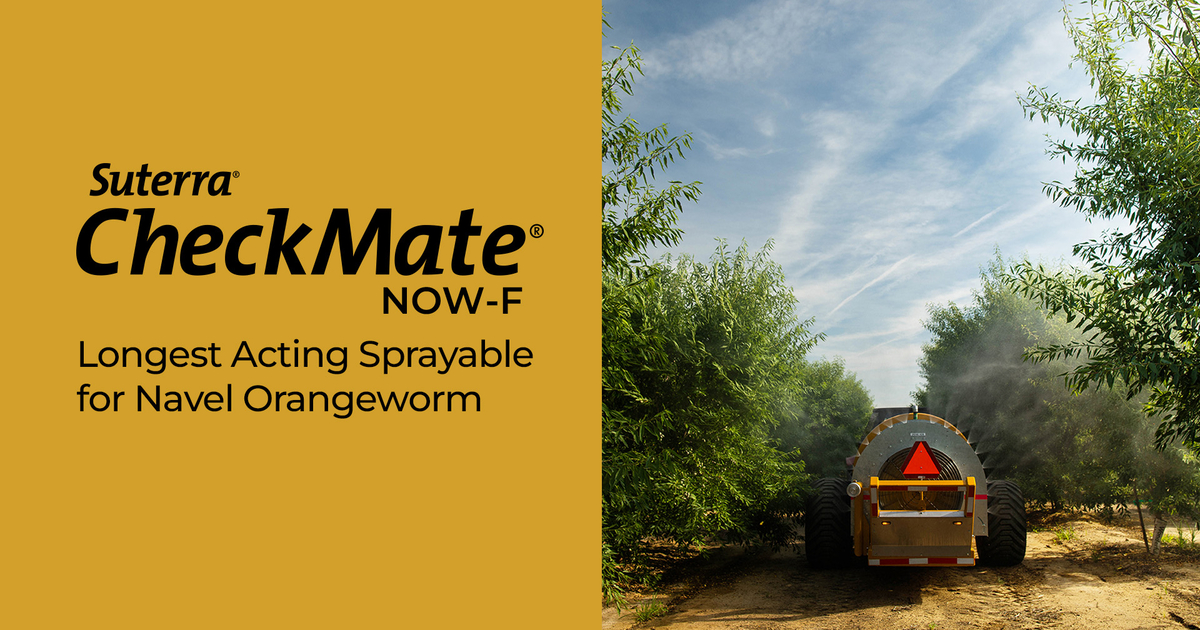 CheckMate® NOW-F
-
Repeat harvest sprays possible for both crops to combat this year's difficult pest season, with zero PHI and MRL exemption.
- Protect the remaining crop from late season navel orangeworm and work towards overall lower damage percentages.
For those using this flexible approach, CheckMate® NOW-F sprayable pheromones can be used to target remaining NOW activity and reduce harvest damage.
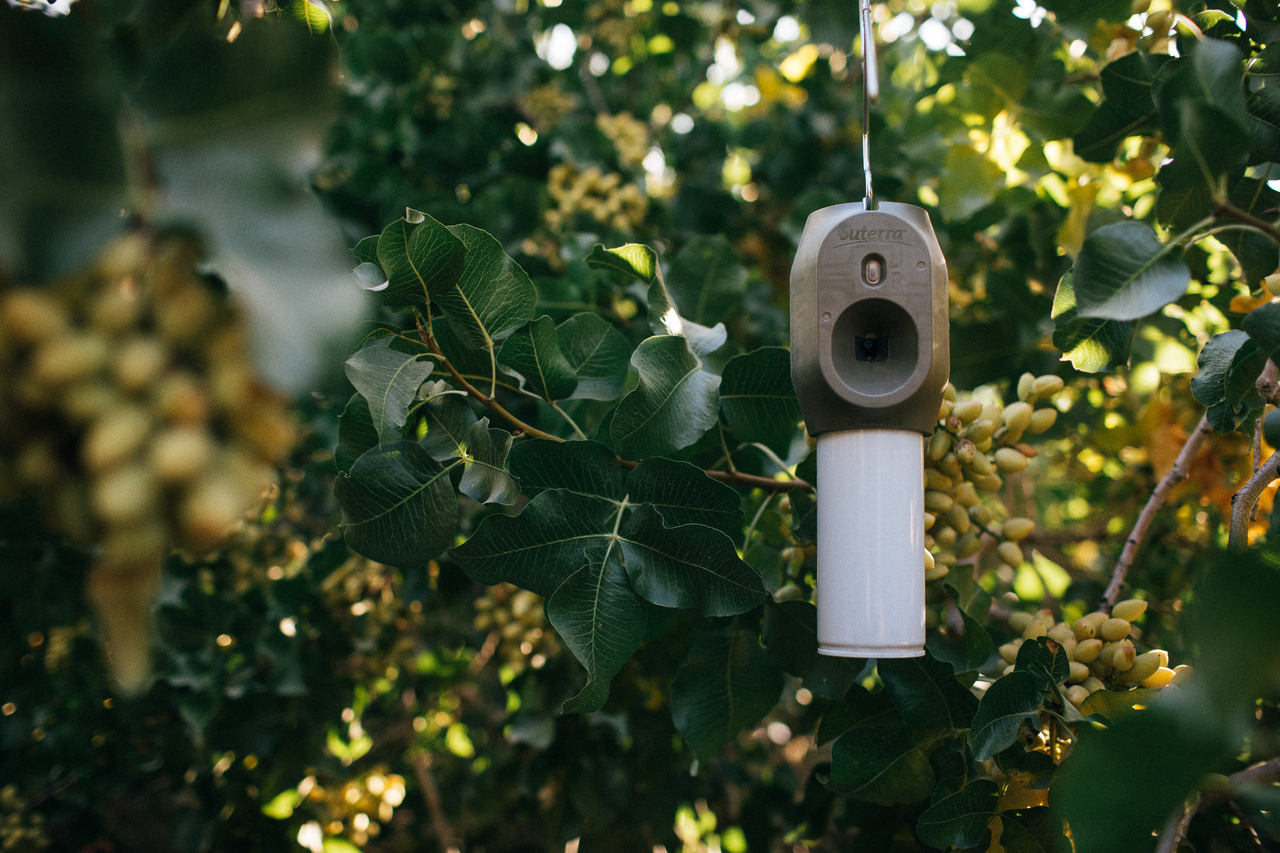
Puffer® NOW-ACE
-
Delivers a precise dose of pheromone for season-long control of navel orangeworm in nut crops.
-
Flexible deployment window with free recycling through our Clean Orchard Promise program.
For those looking weighing their options for next season, Puffer® NOW-ACE provides season-long navel orangeworm control.
August CEU Events
Search for local CEU events using California Department of Pesticide Registration's continuing education course landing page. Browse the new site here.
Here's our top Continuing Education picks for August:
-
Desert Valleys Fall Appreciation Lunch & CE Meeting
Date: September 8th, 2026
Hours: 0.5 laws, 3.5 other
Location: Imperial, CA
Sponsoring Org: Desert Valleys CAPCA Chapter
Contact: (760) 427-1226
Open to the public
Fee required
- CA Farm Bureau Extension: DPR on SPM & Updates
Hours: 1 laws
Location: Webinar
Sponsoring Org: California Farm Bureau
Contact: (925) 989-1621
Open to the public
Fee required
Click to register
Thanks for choosing Suterra as your partner in sustainable pest management.
July 2026
California orchards are entering one of the busiest phases of the growing season. There is no shortage of management tasks in almonds and pistachios this time of year, as growers must carefully balance rising temperatures with tree health and pest management to protect crop quality.
Almond Development Updates
Almond orchards across many regions of California are entering hull split. As hulls begin to open, nuts become more susceptible to navel orangeworm damage. In July, several biological and environmental factors contribute to increased NOW pressure. Warmer temperatures accelerate moth development, multiple generations are active, and maturing nuts release kairomones that attract egg-laying females. This season, some growers are also reporting earlier-than-normal orchard development, making close tracking of hull split, trap catches, and degree-day models even more important for optimizing treatment timing.
Pistachio Development Updates
Pistachio orchards continue kernel fill, with crop loads varying across California due to this year's natural alternate-bearing cycle. As warm summer temperatures persist, growers are focused on supporting tree health and monitoring crop development. Navel orangeworm pressure continues to increase, making trap monitoring and degree-day tracking essential for timing management decisions. Gill's mealybug activity also continues in July, with growers diligently scouting for hot spots. Check in with your processor before applying Gill's treatments to ensure they comply with current MRL requirements.
Key Management Considerations
Optimize Navel Orangeworm Management
- As almonds enter hull split and pistachios approach a period of greater susceptibility, continue monitoring traps and degree-day models to optimize treatment timing. Integrating orchard observations with local pest pressure can help maximize control while minimizing unnecessary applications.
Scout for Secondary Pests
- Continue monitoring orchards for pests such as Gill's mealybug, particularly in hot, dusty conditions where populations can increase rapidly. Early detection allows growers to make timely IPM decisions before infestations become more difficult to manage.
Plan for Harvest
- With early almond varieties approaching harvest, review harvest logistics and orchard sanitation plans. Prompt removal of nuts can help reduce late-season navel orangeworm damage and protect crop quality.
Industry News &
Upcoming Events .jpg?upscale=true&width=1120&upscale=true&name=Image%20(29).jpg)
Excellent news for the industry: earlier this year, Suterra acquired the product lines, active ingredients, and research and development pipeline of Vestaron. This acquisition includes Spear®, an effective and increasingly popular peptide chemistry for lepidopteran management. The company looks forward to providing growers with another strong biological tool for 2027.
Mark your calendars! Growers can connect with the Suterra team on mating disruption and stay informed on the latest developments in pistachio production at American Pistachio Grower's Pistachio Industry Insights Day in Visalia this month.
- Pistachio Insights Day:
- Visalia Convention Center (303 E Acequia Ave, Visalia, CA 93291)
- Friday, July 24, 2026 from 7:30am-3:00pm
- Register for the event here
NOW Mating Disruption Solutions
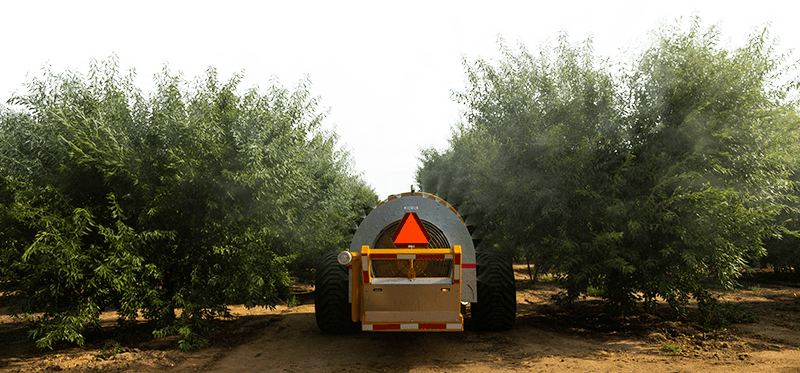
CheckMate NOW-F
- Multiple application timings possible for both crops, from hull split spray to repeat harvest sprays (particularly with zero PHI and no MRLs).
- Prevent population buildup and improve efficacy of IPM treatments at hull split, hull slip, or harvest.
For those using this flexible approach, CheckMate® NOW-F sprayable pheromones can be used to target the remaining generations of NOW and reduce harvest damage.
July CEU Events
The California Department of Pesticide Registration recently updated its continuing education courses landing page. It is now easier for PCAs to search for upcoming local CEU events. Browse the new site here.
Here's our top Continuing Education pick for July:
Advancing IPM: Pollinators, Natural Enemies, and the Economic Value of Habitat
-
Date: July 22nd, 2026
-
Hours: 1.00 other
-
Location: Webinar
-
Sponsoring Org: UC Statewide IPM Program
-
Contact: (530) 213-0140
-
Open to the public
-
No fee required
Thanks for choosing Suterra as your partner in sustainable pest management.
June 2026
Summer has arrived and crop development is accelerating.
The 2026 growing season continues to move quickly for California nut crops. As summer temperatures climb, growers are focused on maintaining tree health, supporting crop development, and managing environmental pressures that may impact yield. Increasing heat events across California's growing regions will shape management decisions in the months leading up to harvest.
.jpg?width=400&height=533&name=Image%20(81).jpg)
Almond Development Updates
Almond orchards throughout California are actively developing kernels and hulls, with trees working hard to keep up with the demands of the crop. This is a good time to stay on top of nutrition, as nutrients like potassium, nitrogen, and phosphorus play an important role in healthy growth throughout the season. Tissue samples and regular orchard checks can help catch deficiencies early and keep orchards on track. As temperatures continue to climb, signs of environmental stress may begin to show, making overall tree health a priority. Heading into summer, maintaining a strong, healthy canopy can help orchards stay productive all the way through harvest.
Pistachio Development Updates
Pistachio orchards continue to look different from one growing region to the next following a lighter crop set or “off year.” As nuts begin to fill, growers are evaluating crop load, tree growth, and overall orchard conditions to help guide management decisions through the summer since rising temperatures place additional stress on trees. Regular orchard evaluations can help growers identify potential issues early and make adjustments that support both this year's crop and next season's production. This season provides an opportunity for trees to rebuild reserves and support next year's crop load. As summer continues, maintaining tree and canopy health remains a priority.
Key Management Considerations for June
- Prepare for Hull Split: Hull split is approaching in many almond-growing regions, making this a good time to review pest management plans.
Monitoring navel orangeworm activity, tracking degree-day accumulation, and considering practices such as mating disruption can help growers prepare for precise hull split applications. - Monitor Tree Health and Summer Stress: As temperatures rise, regular orchard evaluations can help identify signs of environmental stress before they impact tree performance.
Maintaining a healthy canopy and supporting overall tree vigor can help orchards navigate the demands of the summer months. - Evaluate Nutrition Programs: Crop demands continue to increase as nuts develop in both almonds and pistachios.
Tissue sampling and orchard observations can provide valuable insight into nutrient status and help guide in-season fertility decisions. - Pistachio Crop Load Considerations: With crop loads varying across orchards this season, management programs may require adjustments based on orchard conditions.
In lighter-cropping blocks, growers may have opportunities to support tree recovery and encourage strong return bloom potential for next season.
.jpg?width=400&height=533&name=Image%20(82).jpg)
June Resources: Tracking Degree Days for Navel Orangeworm
As summer temperatures increase across California, growers and PCAs are reviewing their navel orangeworm management plans. While no two seasons are the same, and this year appears to be trending early, the second flight of navel orangeworm will be occurring soon throughout the state. Now is a good time to evaluate orchard needs and ensure you have enough product on hand.
For almond growers, this is a critical time because hull split is rapidly approaching. Crop vulnerability increases significantly at hull split, with many growers carefully planning their navel orangeworm treatment timings. For pistachio growers following the January 1 degree-day model, 1700 degree days is a key time to consider navel orangeworm sprays targeting the second flight to prevent future population buildup and damage.
Many nut crop growers qualify for our special CheckMate® NOW-F rebate, providing an opportunity to protect their orchards and premiums while reducing input costs. Click the link above or visit our website to learn more about rebate eligibility and program details.
NOW Mating Disruption Solutions
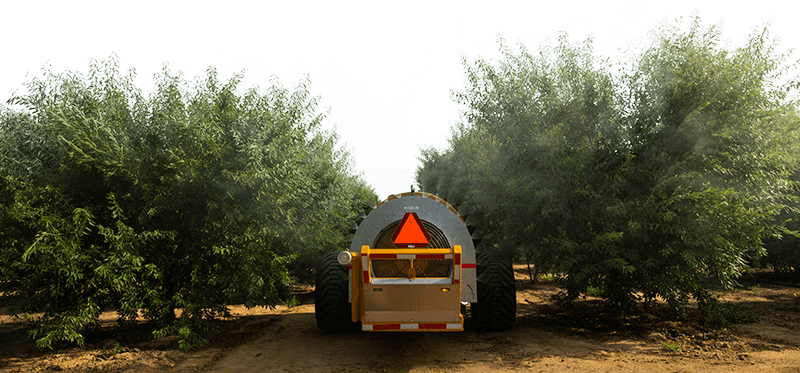
CheckMate NOW-F
- Multiple application timings possible for both crops, from hull split spray to repeat harvest sprays.
- Prevent population buildup and improve efficacy of IPM treatments at hull split, hull slip, or harvest.
- Three spray rebate program: Apply CheckMate NOW-F three times at the recommended label rate to the same acreage within a single growing season to qualify for a rebate.
For those using this flexible approach, CheckMate® NOW-F sprayable pheromones can be used to target the remaining generations of NOW and reduce harvest damage.
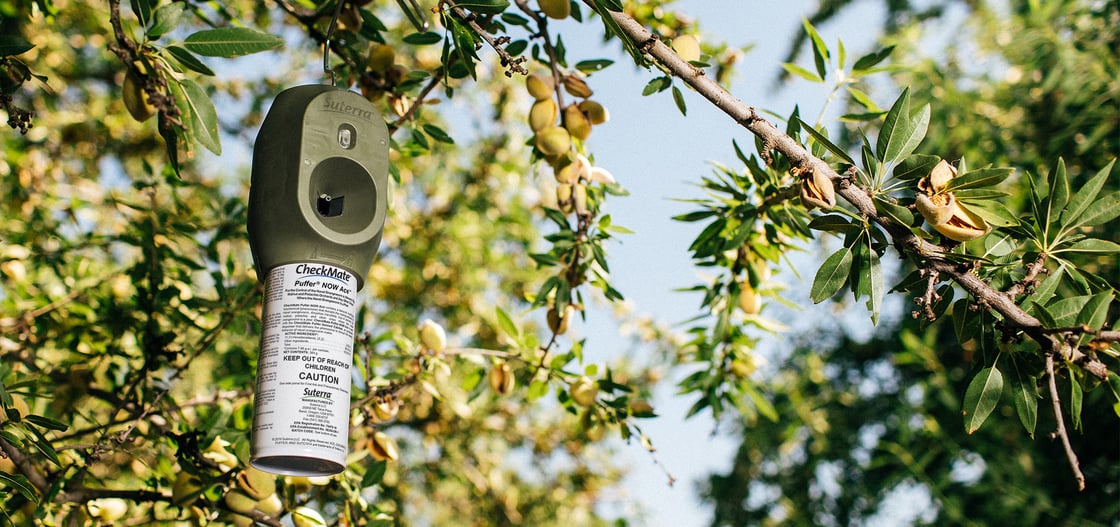
Puffer NOW Ace
- Delivers a precise dose of pheromone all season-long to provide worry free control of navel orangeworm in both nut crops.
- Designed with pest biology in mind: Puffer only emits pheromone when navel orangeworm is active throughout the season.
- Free recycling through our Clean Orchard Promise program.
Growers who have opted for season-long control using Puffers® should feel confident that they have made a sound decision that will deliver strong ROI.
June CEU Events
The California Department of Pesticide Registration recently updated its continuing education courses landing page. It is now easier for PCAs to search for upcoming local CEU events. Browse the new site here.
Here's our top Continuing Education pick for June:
Pistachio Day: Decisions That Will Shape Your Crop This Year
Date: June 17th, 2026
Hours: 2.00 other
Location: Tulare, CA
Sponsoring Org: JCS Marketing
Contact: (559) 352-4456
Open to the public
No fee required
Click to register
Thanks for choosing Suterra as your partner in sustainable pest management.
May 2026
A Fast Start to the Season Brings New Challenges
The 2026 growing season continues to move quickly for California nut crops. A warm spring period accelerated bloom in both almonds and pistachios, pushing orchards ahead of historical averages throughout much of the Central Valley. Since then, cooler temperatures and intermittent spring storms have added variability to the season, leaving growers to balance rapid crop development and weather-driven challenges.
With orchards in active development, California growers are navigating one of the busiest periods of the year, managing inputs, and orchard health to set the stage for a strong harvest.
Almond Development Updates
Almond orchards throughout California are in the midst of kernel development and hull expansion. Rapid spring growth and warmer early-season temperatures have accelerated tree demand, making crop input decisions heading into the summer months important.
Many growers are reporting good canopy growth and healthy spur development. However, crop load remains variable due to bloom conditions, pollination challenges, and orchard location. With orchards in the peak of the growing season, maintaining healthy leaf area and supporting carbohydrate production is crucial for this year’s crop development and next year’s bud formation. Adequate nutrient levels of potassium, nitrogen, magnesium, and phosphorus continue to play important roles in photosynthesis, carbohydrate movement, and overall tree energy balance.
Pistachio Development Updates
The 2026 pistachio season has been just as challenging and variable across California growing regions. Industry forecasts project a lighter crop load due to the natural alternate-bearing cycle, with some orchards also experiencing reduced nut set following warm temperatures at bloom.
Several growing regions experienced temperatures exceeding 95°F during critical bloom windows in March, which impacted pollen viability, flower retention, and nut set. Many growers are closely monitoring nut fill and adjusting management strategies to fit crop needs. In lighter crop years, maintaining tree health is especially important as pistachio trees simultaneously develop this season’s crop while initiating buds for next year’s production. As summer approaches, growers should continue evaluating tree stress and crop load variability.
Key Management Considerations for May
NOW Monitoring:
- Monitoring for navel orangeworm and other pests should continue across almond and pistachio orchards as flight activity increases with warmer temperatures.
- Tracking trap counts, degree-day accumulation, and crop stage can help growers nail down precise treatment timing.
Crop Nutrition + Canopy Health:
- Strong canopy health and balanced fertility continue to play important roles in supporting tree resilience throughout the season.
- Maintaining adequate nutrient levels through tissue sampling and targeted applications can help support carbohydrate production, nut fill, and next year’s bud development.
May Resources: Events, NOW Pressure, and the Subjective Almond Forecast
.jpeg?upscale=true&width=1120&upscale=true&name=IMG_1506%20(1).jpeg)
Given the time of the season, there are few industry events scheduled for May. If you happen to farm grapes in addition to nut crops, you can connect with our team at:
- Vineyard Team's 2026 Industry Update
May 20th, 2026, 9:00am - 1:00pm
900 El Camino Real, Atascadero, CA 93422.
Register here
Our team is also available to provide technical support for growers navigating pest management decisions. Navel orangeworm activity picks up as temperatures warm in both almond and pistachio orchards, and timing mating disruption treatments correctly can make a meaningful difference in suppression of the remaining flights.
Wondering how a lighter almond crop affects your NOW risk after USDA NASS published its subjective almond forecast? Our latest blog breaks down how crop density impacts pest pressure and which mating disruption tools can help protect your quality and returns.
Mating Disruption Solutions
CheckMate NOW-F
- Multiple application timings possible for both crops, from hull split spray, to multiple harvest sprays.
- Prevent population buildup and improve efficacy of later IPM treatments in spring, hull split, or post-harvest.
- Three spray rebate program: Apply CheckMate NOW-F three times at the recommended label rate to the same acreage within a single growing season to qualify for a rebate.
For those not using this full-season approach, CheckMate® NOW-F sprayable pheromones can be used to target the remaining generations and reduce harvest damage.
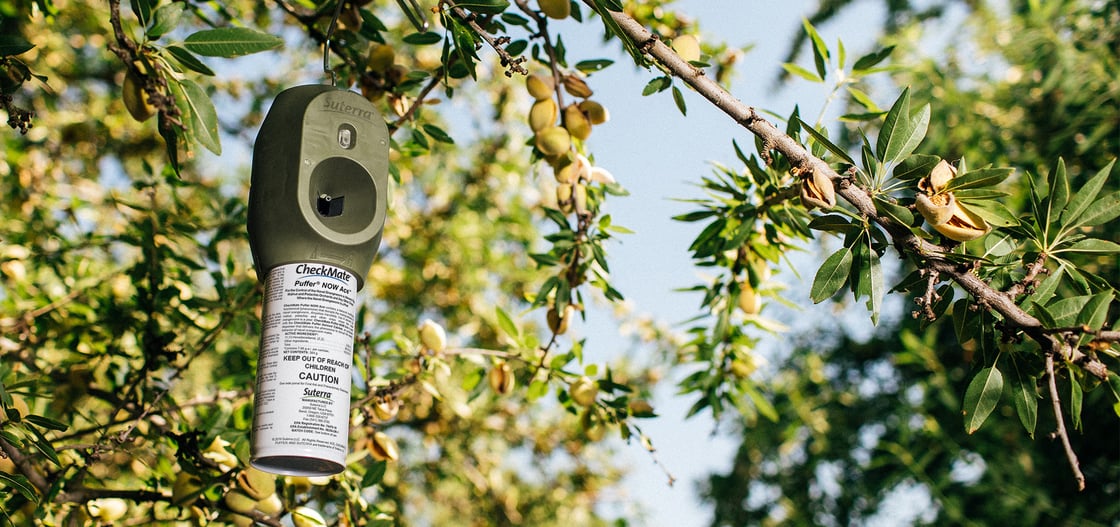
Puffer NOW Ace
- Delivers a precise dose of pheromone all season-long to provide worry free control of navel orangeworm in both nut crops.
- Designed with pest biology in mind: Puffer only emits pheromone when navel orangeworm is active throughout the season.
- Free recycling through our Clean Orchard Promise program.
Growers who have opted for season-long control using Puffers® should feel confident that they have made a sound decision that will deliver strong ROI.
April 2026
Although this April brings warmer than normal temperatures to California’s nut crop growing regions, growers remain hopeful. In terms of spring orchard phenology, both almond and pistachio trees are devoting resources to early crop formation. Almonds have concluded bloom in all parts of the state and moved on to nut set, while pistachios continue to bloom throughout the state. Nut set and yield will be shaped by a combination of grower management decisions alongside weather in the coming months, whether that's heat, rain, or something in between.
Almond Updates
Last month, almond orchards completed bloom across California's Sacramento and San Joaquin Valley growing regions. Flower petals dropped, pollination concluded, and early nut development began. Vegetative growth also increased, filling out tree canopies and allowing for capture of solar energy for photosynthesis. Nuts that were successfully pollinated will continue to develop, forming small nutlets that increase in size as the growing season progresses. From a management standpoint, growers should keep a close eye on navel orangeworm and mite pressure as conditions remain warm.
Pistachio Updates
Last month, pistachio orchards broke dormancy across California. Vegetative and reproductive buds began to swell, followed shortly by bloom in several of the major production regions. Pistachios are dioecious (separate male and female reproductive structures) and wind pollinated. This means that male inflorescences or flowers release pollen for receptive female flowers. A synchronized bloom period of male and female trees, as well as successful wind pollination is essential for establishing a strong crop. From a management standpoint, growers continue to monitor bloom, pollen availability, and prepare nutrition programs to support crop development.
Key Production Considerations
- Almond Disease Management: With hull and shell development underway, protecting nuts from fungal disease is a priority. Apply fungicide treatments as needed, especially after rainfall.
- Orchard Pest Management: Navel orangeworm development continues at a faster pace as temperatures warm. Growers who did not deploy Puffers® for season-long mating disruption should apply sprayable pheromones in late April or throughout May to target the first flight. Pistachio growers applying Centaur for treatment of Gill's Mealybug crawlers should do so before budbreak but no later than April 15th to avoid MRL issues.
- Nutrition: April is a key window for nutrient applications. Nitrogen and Potassium applications in almonds may assist shell development. Pistachio growers may apply supplemental Zinc or Boron to support early fruit set and shoot growth.
- Pollination Monitoring (Pistachios): Confirm adequate pollen availability and monitor bloom overlap between male and female trees. Note any irregularities in bloom timing that could affect fruit set, and document observations to inform future orchard management decisions.
Early-Season Pest Management Support
There are no major industry events scheduled for April. However, our team is available to provide technical support for growers navigating early-season pest management decisions.
Navel orangeworm activity picks up as temperatures warm in both almond and pistachio orchards, and timing mating disruption treatments correctly can make a meaningful difference in suppression of the first flight.
If you have questions about product selection, application timing, or program design for your operation, don't hesitate to reach out. Our team is here to help you get the season started on the right foot.
March 2026
As we move into March, the pace of the California nut crop growing season is starting to pick up. Almond orchards are transitioning out of bloom and into early nut development, while pistachio orchards are just experiencing bud swell and preparing for bloom. This physiological window is significant for both almond and pistachio trees because their plant structures are working diligently to form this season's crop. Weather events as well as early-season management decisions this month will shape yield outcomes in 2026.
Almond Updates
Last month, bloom erupted across California almond orchards. The Sacramento and San Joaquin Valley growing regions experienced a few notable weather events (significant rainfall, low temperatures) which limited bee pollination activity and orchard access for growers. From a phenology perspective, this month several almond varieties will complete bloom, shed their petals, and begin early nut development. As leaves begin to push and canopies expand, trees will start to capture solar energy for photosynthesis. As far as management is concerned, growers are focused on protecting developing nuts from disease, monitoring early-season insect activity, and aligning nutrition programs with tree demand.
Pistachio Updates
Last month, pistachio orchards remained dormant across California, quietly accumulating chill hours and preparing for this year’s growing season. This month, vegetative and reproductive buds are beginning to swell, signaling the approach of bloom. Bud development in pistachio trees is a biological starting point for the season’s crop. Vegetative buds will push new shoots and leaves, allowing trees to capture sunlight while reproductive buds on male and female trees will become the flower clusters that facilitate pollination. As far as management is concerned, growers can monitor for early-season pest activity and prepare nutrition programs to supplement tree growth
Key Production Considerations
-
Almond Sanitation: Ensure any remaining nuts on orchard floors are flail mowed or destroyed by early March.
-
Orchard Pest Management:
Start the growing season off strong with mating disruption. If using Puffers to treat navel orangeworm, be sure to hang by late March or early April. If using sprayable pheromones, start planning NOW-F April applications to target the first flight.Pistachio growers should begin monitoring for overwintering Gills Mealybug nymphs underneath tree bark. These nymphs mature into the adult females that produce the first generation of crawlers, which are typically treated just before bloom.
-
Nutrition: Consider replacement applications of Nitrogen or Potassium to maintain yields and long-term health of almonds. Pistachios may do supplemental applications of Zinc or Boron.
-
Chill hours tracking: Continue monitoring chill accumulation in pistachios to anticipate bloom timing and pollination patterns.
Upcoming Industry Events:
Interested in pheromone education? Connect with us at an upcoming industry event in March:
- March 5th, 2026: 2026 UCCE Stone Fruit Day at the Kearny REC in Parlier, CA. Members of our Grower Relations and Technical Field Team will be attending the event and eager to discuss our wide array of Oriental fruit moth mating disruption solutions.
- March 18th, 2026: Soil Health Field Days at Chico State in Chico, CA. Dominic Delucci our Grower Relations Chico resource will be attending the event and happy to talk mating disruption options for the upcoming tree nut growing season.
- March 19th, 2026: CAPCA Fresno Madera Spring CE Meeting at the Kerman Community Center (15101 W Kearney Blvd. Kerman, CA 93630). Haydn Lenz, Technical Field Specialist, will be giving an in depth label update on our current mating disruption solutions for navel orangeworm and vine mealybug.
February 2026
The California nut crop growing season has begun. While pistachio development tends to lag slightly behind almond development during the growing season, the objectives of both crop systems are the same: to increase yield while producing a high-quality crop. As growers know, no two seasons are the same, and orchard characteristics such as bud development, bloom, and pest pressure are influenced by a combination of early management decisions and environmental conditions.
Almond Updates
California almond orchard development is progressing quickly. At the end of last month bud swell, the period when dormant buds enlarge and form flower or vegetative structures, began throughout the state. As tree growth continues, flowering buds will move through the pink bud stage, popcorn stage, then early bloom. Bloom is just around the corner and is significant from a management perspective because growers must finalize their sanitation efforts, coordinate supplemental pollination based on bloom progression, take precautions against weather related injury, and begin early-season pest monitoring
Pistachio Updates
For California pistachio orchards, tree development is picking up slowly. During this month, trees are accumulating the last of their chill hour requirements. While each pistachio cultivar has different requirements, the crop itself generally needs a large number of hours within a specific chill threshold to reach its full developmental capacity. If chill is insufficient or uneven due to fluctuations in environmental conditions or orchard design, it can lead to uneven bloom, disrupting the pollination process between male and female trees. During this time, growers may be finishing up the last of their winter pruning, calculating predictions for bloom timing, reviewing nutrient application programs, and finalizing their early season pest management tactics.
Key Production Considerations
- Winter sanitation: The majority of sanitation should be completed by early February. Ensure any remaining nuts on orchard floors are destroyed.
- Almond pollination: Almond growers and bee keepers should communicate on hive placement and safe orchard practices to protect pollinators during the bloom period.
- Orchard Pest Management: For almond orchards affected by peach twig borer, applications of Bacillus thuringiensis can help provide control with minimal impact to honey bees.
- Chill hour tracking: Continue monitoring chill accumulation in pistachios to anticipate bloom timing and pollination patterns.
- Dormant pruning: Remove diseased wood and manage canopy structure in pistachios while trees are inactive.
Team Event Spotlight
Did you have a chance to meet our team at this year's Statewide Pistachio Day in Visalia? The University of California's Agriculture and Natural Resources hosted an informative event showcasing research updates in the pistachio system. Our team participated in several sessions related to ongoing and emerging pest management issues to inform Suterra's product innovation pipeline.
Members of our Grower Relations team, Collin Scholl and Connor Cunningham were also on hand in the exhibition area and able to connect with a variety of industry professionals on best practices for use of our navel orangeworm mating disruption solutions.
Live Educational Events
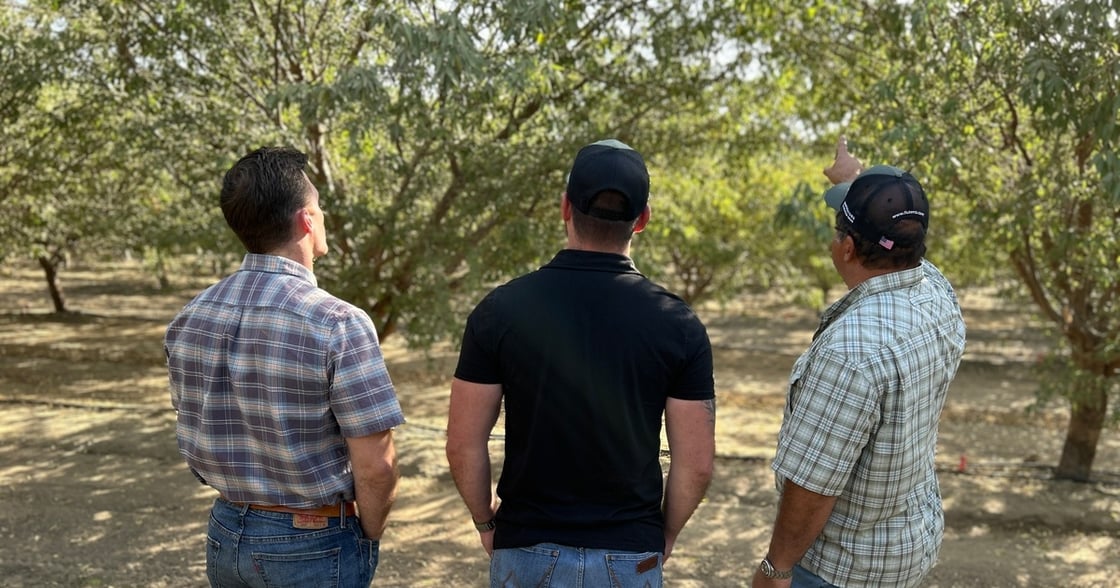
Interested in pheromone education or have a question for our team?
Connect with us at an upcoming industry event in February:
- February 4th, 2026: Tulare-Kings CAPCA Label Update at T.D.E.S. Portuguese Hall in Tulare, CA. Our Technical Field Specialist, Haydn Lenz, will be presenting on mating disruption solutions in nut crops, grapes, and citrus at 8:30am.
- February 5th-6th, 2026: AAIE Annual Conference at the Double Tree in Modesto, CA. Members of our Technical Field Team will be at the event and look forward to informative discussions on the state of pest management in nuts, citrus, and vines.
- February 18th, 2026: APG Annual Conference in Indian Wells, CA. Members of our Grower Relations Team will be at the event to support growers with any NOW mating disruption questions.
- February 18th, 2026: 2026 California Blueberry Day at the Visalia Convention Center in Visalia, CA. Members of our Grower Relations and Technical Field Team will be at the event to support the launch of our BioMagnet Ruby device for control of spotted wing drosophila.
- February 24th, 2026: CAPCA Ventura CE Meeting at the Moose Lodge in Ventura, CA. Our Technical Field Specialist, Haydn Lenz, will be presenting on mating disruption solutions in citrus and grapes as well as our latest attract-and-kill technology in berries at 8:00am.
January 2026
As the new year begins, California nut crops orchards remain largely dormant. However, January is a critical month for management decisions. Choices that growers make around their sanitation will directly influence navel orangeworm pest pressure later in the year.
Almond Updates
Almond orchards are still in winter dormancy through much of January, though some early varieties may begin to display bud swell by the end of the month in warmer growing regions. Winter sanitation remains a top priority, as removing mummy nuts reduces resources for overwintering navel orangeworm populations and helps lower early season pressure.
Orchard floor management, including maintaining or establishing winter cover crops continues to support soil health and water infiltration before the start of the growing season. Some operations may also begin dormant pruning at this time to remove diseased wood and prepare trees for uniform bloom later in the season.
Pistachio Updates
Pistachio trees are fully dormant in January, prioritizing carbohydrate and nutrient storage following last year’s growing season. Growers should continue to closely monitor chill hour accumulation, as adequate chill is essential for synchronized bloom and successful pollination of male and female pistachio trees.
Some growers have begun dormant pruning to manage trees shape and remove dead or diseased limbs. Soil sampling may also be done at this time to get a read on nutrients, inform spring fertilizer applications, and allow growers to address any deficiencies before bloom and nut development begins.
Key Production Considerations
-
Winter sanitation: Ensure removal and destruction of mummy nuts to eliminate resources for development of early generation navel orangeworm and population carryover into spring.
-
Chill hour tracking: Continue monitoring chill accumulation to anticipate bloom timing and pollination patterns.
-
Dormant pruning: Remove diseased wood and manage canopy structure while trees are inactive.
-
Soil and orchard floor management: Conduct soil testing and maintain cover crops to support early-season growth.
From the Field
.jpg?width=1024&height=1020&name=Image%20(29).jpg)
Did you stop by our booth at the Almond Conference in December? The Suterra team enjoyed connecting with growers and industry partners to discuss our innovative mating disruption solutions for navel orangeworm.
Key Account Managers Collin Scholl and Brent Deborde, Director of Sales Carlos Bassa, and Technical Content Marketer Celeste Torres were on hand to answer questions about integrated pest management program design, deployment timing, and NOW management strategies.
We appreciated everyone who stopped by our booth and participated in our hat bar. We heard from many attendees that it was a highlight of the conference.
Live Educational Events
Interested in pheromone education or have a question for our team? Connect with us at an upcoming industry event in January:
- January 21st, 2026: Statewide Pistachio Day at the Visalia Convention Center in Visalia, CA. Stop by our booth to hear more about available mating disruption solutions for navel orangeworm in the pistachio system.
- January 26th, 2026: Kern County Winter Label Update at Luigi's Warehouse in Bakersfield, California. Our Key Account Manager, Collin Scholl, will be presenting on mating disruption solutions in nut crops, grapes, and citrus at 8:45am.Visit our table at the event for one on one time with one of our experts.
- January 27-29th 2026: Unified Wine and Grape Symposium at SAFE Credit Union Convention Center in Sacramento, California. Our product portfolio manager, Sarah Chapman, will be attending the event and available to chat about mating disruption solutions for wine, table, or raisin grapes.
December 2025
Just a few months ago California nut crop orchards were alive with activity. Now, temperatures are falling, daylight hours are shorter, and trees are settling into winter shutdown. Almonds and pistachios go dormant in December, which means they are physiologically focused on nutrient and carbohydrate storage rather than leaf or nut development. Growers can use this brief reprieve to knock out important orchard management tasks.
Almond Updates
California almond orchards are settling into dormancy, which means trees are building up nutrient reserves for the next growing season. This resting phase is the perfect time to focus on orchard floor maintenance by planting winter cover crops. Cover crops may help improve soil health and water infiltration, as well as provide habitat for pollinators ahead of bloom. December is also the month to start winter sanitation. Removal of mummy nuts leaves few resources for overwintering navel orangeworm, which means lower populations in orchards come spring time. Growers should aim to have all of their mummies removed (via shaking or poling) by February 1st of next year.
Pistachio Updates
Pistachios are also experiencing a period of rest in December. Trees are using this downtime to rebuild carbohydrate reserves after a high-yield "on" production year. Growers are currently focused on monitoring chill hour accumulation, which gives operations a good indication of when to expect budbreak and what bloom patterns might look like in the spring. Chill hour accumulation begins on November 1st, and aims to count the number of hours with orchard temps between ~32°F-47°F. It is important that trees experience an adequate amount of chill in order for male and female bloom to occur in sync. If not, poor pollination may occur, leading to lower nut set and increased blanks.
Key Production Considerations
- Winter Sanitation: Begin the process of removing mummy nuts from orchards. Identify areas of historically high pressure or those with large numbers of mummies to prioritize.
- Cover Crops: Consider planting a winter cover crop to improve soil health and increase pollinator habitats in the spring.
From the Field
.jpg?width=628&height=556&name=Image%20(25).jpg)
Photo: Kayla Manning, Customer Experience Manager at Suterra
-
Did you stop by our booth at the Blue Diamond Growers Annual meeting in November? Ignacio Valdez and Ralph Gutierrez had the opportunity to discuss their area of expertise: field service. Suterra is proud to offer local expertise to California growers across the state.
Live Educational Events
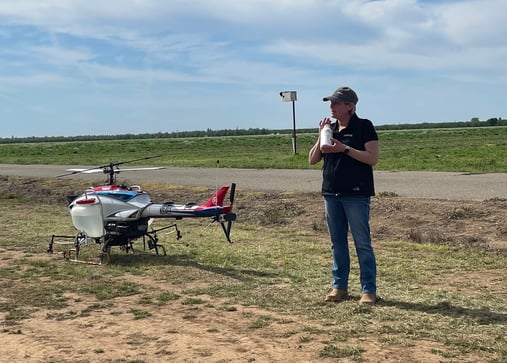
Photo: Emily Symmes, Ph.D., shares the advantages in drone applications of sprayable NOW pheromones at Chico State's Center for Regenerative Agriculture.
Interested in pheromone education or have a question for our team? Connect with us at an upcoming industry event:
- December 4th: NW Hort Expo in Wenatchee, WA
- December 10-12th: Almond Conference in Sacramento, CA
November 2025
As California’s nut crop harvest comes to a close, trees begin transitioning into their dormant phase. November brings cooler temperatures and shorter daylight hours, signaling trees to shift energy from photosynthesis to nutrient storage for winter. Dormancy allows trees to replenish nutrients for the next season, and for growers to complete post-harvest management tasks.
Almond Updates
Almond orchards across California are moving into dormancy. There are several production practices that growers can complete to support early shoot growth and bloom in 2026. Orchard tissue and soil sampling may identify nutrient imbalances among blocks, guiding fertilizer or soil amendment applications. Fall applications of boron, zinc, and potassium have demonstrated a variety of positive orchard results. Growers may also randomly sample spurs throughout the orchard to determine if scale and mite treatment is necessary. If you haven’t evaluated your 2025 harvest samples, now is a great time to do so, as the results may inform pest management strategies for next year.
Pistachio Updates
Pistachios and almonds are experiencing similar physiological milestones in November. All pistachio orchards in California have completed their harvest, and trees are starting to wind down into dormancy. Pistachios are alternate bearing trees, and because 2025 was an “on” year, tree carbohydrates and nutrients were depleted and need time to regenerate. Pistachio trees also require a certain amount of chill hours to ensure strong development and uniform bloom in spring. Growers may track chill hours from November to February to get a better idea of what to expect at bloom. Although orchard management varies from grower to grower, some UC farm advisors suggest holding off on nutrient applications until spring to avoid loss during winter leaching that may occur.
Key Production Considerations
- Postharvest Sanitation: Continue surveying orchards for mummy nuts and implement winter sanitation programs. Identify areas of historically high pressure or those with large numbers of mummies to prioritize.
- Tree Recovery: After harvest, replenish almond orchards with nutrient applications to support bud development and ensure tree health heading into dormancy.
- Cover Crops: Consider planting cover crops to improve soil health and increase pollinator habitats in the spring.
- Pruning: Avoid pruning damaged branches from trees before rainfall events, as this can lead to the rapid spread of disease.
From the Field
.jpg?width=1024&height=716&name=Image%20(8).jpg)
Photo: Jeanie Morton, Marketing Project Manager at Suterra
- Did you meet the Suterra team at this year’s CAPCA Annual Conference? In addition to fielding PCA and grower questions at our booth, we had the opportunity to present a few times on the main stage. Emily Symmes, Ph.D., highlighted the future of chemical drone applications, sharing in-field examples and results. Haydn Lenz, PCA, presented a label update on our new organic formulation of vine mealybug pheromone. As always, we are proud to partner with industry professionals to advance effective, sustainable pest management.
Live Educational Events
Interested in education about pheromone delivery systems or have a question for our team? Connect with us at an upcoming industry event:
- November 10-11: Sustainable Ag Expo in San Luis Obispo
- November 19: Blue Diamond Annual Grower Meeting in Modesto
October 2025
California’s nut crop orchards are nearing the end of their harvest season. Almonds have wrapped harvest up for the most part, while pistachios are in the middle of shakes. For growers, the urgency of harvest activities is quickly followed by planning for the next season.
Almond Updates
Almond orchards in California are finishing harvest on late varieties. Timely removal of nuts, in this case from orchard floors, is important to prevent ant feeding, aflatoxin contamination, and further losses in crop quality due navel orangeworm feeding. With the bulk of harvest out of the way, growers can begin to focus on nutrient management to replenish trees for next year’s growing season. Growers can also begin mummy nut surveys to determine which areas of the field to focus their winter sanitation efforts.
Pistachio Updates
Pistachio harvest is bustling this month, with shakers and haulers working overtime to collect this season’s crop. At this point in the season hull slip percentages in nuts are high, which means the quicker they’re harvested, the less navel orangeworm damage. Growers should keep an eye on areas with heavy nut staining, mealybug activity, or other types of insect damage. Harvesting these areas sooner may help prevent losses in crop quality and determine areas of focus for next season.
Key Production Considerations
- Postharvest Sanitation: Begin surveying almond orchards for mummy nuts and planning winter sanitation programs. Identify areas of historically high pressure or those with large numbers of mummies to prioritize.
-
Navel Orangeworm: Continue monitoring pistachio blocks through the end of harvest to minimize late-season damage. In both crops, evaluate this season’s integrated pest management program using harvest samples to guide adjustments for next year.
-
Gill’s Mealybug: As harvest continues, keep an eye on historically infested orchards. Postharvest is a good time to examine population pressure and map areas for targeted management next season.
-
Tree Recovery: After harvest, replenish orchards with nutrient applications to support bud development and ensure tree health heading into dormancy
- Cover Crops: Consider planting cover crops to improve soil health and increase pollinator habitats in the spring.
- Pruning: Avoid pruning damaged branches from trees before rainfall events as this leads to the rapid spread of disease.
From the Field
.jpeg?width=716&height=716&name=IMG_1118%20(1).jpeg)
Photo: Celeste Torres, Suterra, Technical Content Marketer
- Isaac Bocker (Field Service Representative Lead) and Collin Scholl (Key Accounts Manager) worked with growers at an orchard in Kern County to collect late-season almond varieties. Damage assessments done on these final varieties help give a more complete picture of this season's insect damage.
Suterra Speaking Events
Interested in hearing us talk in depth about our pheromone delivery systems or have a question for our team? Attend one of our presentations at the dates listed below:
- October 19th-21st: CAPCA Annual Conference in Reno, Nevada:
- Suterra's Emily Symmes, Ph.D., will present on the main stage regarding the future of pheromones in the context of drone application technology.
- Haydn Lenz will also present a label update on CheckMate VMB-O, an organic formulation of our sprayable pheromone for control of vine mealybug.
September 2025
California's nut crop orchards are full of activity as harvest season continues. Despite a staggered harvest window for almonds and pistachios, one thing is certain for both systems: removal of nuts must be carefully timed to avoid losses in crop quality.
Almond Updates
Almond orchards across California are well into harvest, with many growers finishing up their Nonpareils and moving into pollinizers. Getting trees shaken and crop removed from the orchard floor in a timely manner are both crucial to preserving nut quality. Prolonged amounts of time in trees or on orchard floors increases the likelihood of navel orangeworm damage, aflatoxin contamination, hull rot, and ant feeding.
Pistachio Updates
Pistachio orchards have begun harvesting. Pistachio hulls naturally degrade as nuts ripen, which signals harvest time for growers. Because hull slip percentages are high in major production areas, the sooner the crop is harvested, the less exposure to navel orangeworm and other orchard pests. This is especially true for early-splitting varieties such as Golden Hills or Lost Hills. As nuts are collected, growers should keep and eye out for nut staining and insect damage.
Key Production Considerations
- Post-harvest sanitation: As harvest comes to a close, growers should begin to plan for post-harvest sanitation. Winter mummy removal is one of the most effective strategies to reduce NOW pressure in the next season.
- Navel orangeworm: Continue evaluating almond harvest samples to assess the effectiveness of this season’s IPM plan. Monitor populations closely in pistachios and apply last minute sprayable pheromone treatments to lower populations throughout harvest.
- Gill's Mealybug: Populations can easily be spread from field to field via harvest equipment and bins. Keep in mind which fields have historically high pressure in order to avoid cross contamination among fields during harvest
From the Field
Video: Celeste Torres, Suterra Technical Content Marketer
- The Suterra team has been hard at work in almond orchards throughout the year. With our trial season coming to a close, the team came together earlier this month in the Kern County area to collect Nonpareil samples for a "crack out" damage assessment.
Suterra Speaking Events
- Suterra has been at the forefront of mating disruption research and development for four plus decades. Interested in hearing us talk in depth about our pheromone delivery systems or have a questions for our team? Attend one of our presentations at the dates listed below:
- 9/12 CAPCA Central Valley Label Update: Modesto Junior College Ag Pavilion, Modesto, CA. Register Here
- 9/18 CAPCA Ventura Fall Continuing Education Day: 10269 Telephone Rd, Ventura, CA. Register Here
- 10/19-10/21 CAPCA Annual Conference in Reno, Nevada: Suterra's Emily Symmes, Ph.D., will present on the main stage regarding the future of pheromones in the context of drone application technology. Haydn Lenz will also present a label update on CheckMate VMB-O, an organic formulation of our sprayable pheromone for control of vine mealybug.
August 2025
California nut crops are headed towards the final stretch of the growing season. While nut development is almost complete and harvest activities are beginning, late-season pest pressure remains a top management priority.
Almond Updates
Almond orchards throughout California are deep into hull split, with harvest already starting in some regions. As machinery enters the field, keep in mind that timely harvest can immensely help protect against crop quality losses, pest damage, and hull rot.
The longer almonds stay on trees, the more susceptible they are to navel orangeworm damage because their shells remain exposed for egg laying and aflatoxin exposure. Once shaken from trees and windrowed, it is also important to move nuts from orchard floors to prevent ant damage.
Pistachio Updates
California pistachios are nearing maturity, with kernel fill wrapping up and harvest preparation underway. As hulls begin to soften and produce early splits, it’s a good idea to monitor for navel orangeworm activity, especially in early-splitting varieties (Golden or Lost Hills) or high pest pressure areas.
Trap counts and degree-day models may help pre-harvest NOW insecticide or sprayable pheromone applications. Growers should also watch for late-season activity of Gill’s mealybug on pistachio clusters. If second-generation crawlers were not adequately treated, populations may increase in August.
Key Production Considerations
- NOW: In almonds, collect harvest samples to evaluate your integrated pest management program. In pistachios, monitor pest populations accordingly to time any last-minute insecticide or sprayable pheromone treatments.
- Gill's Mealybug: Scout pistachio clusters in historically high-pressure blocks, consider late-season treatments depending on population levels.
- Harvest Prep: Monitor nut maturity and hull split to time shakes accurately, coordinate with processors to reduce delays.
- Sanitation Planning: Start mapping blocks for mummy counts, as winter sanitation is one of the most effective NOW control strategies.
From the Field 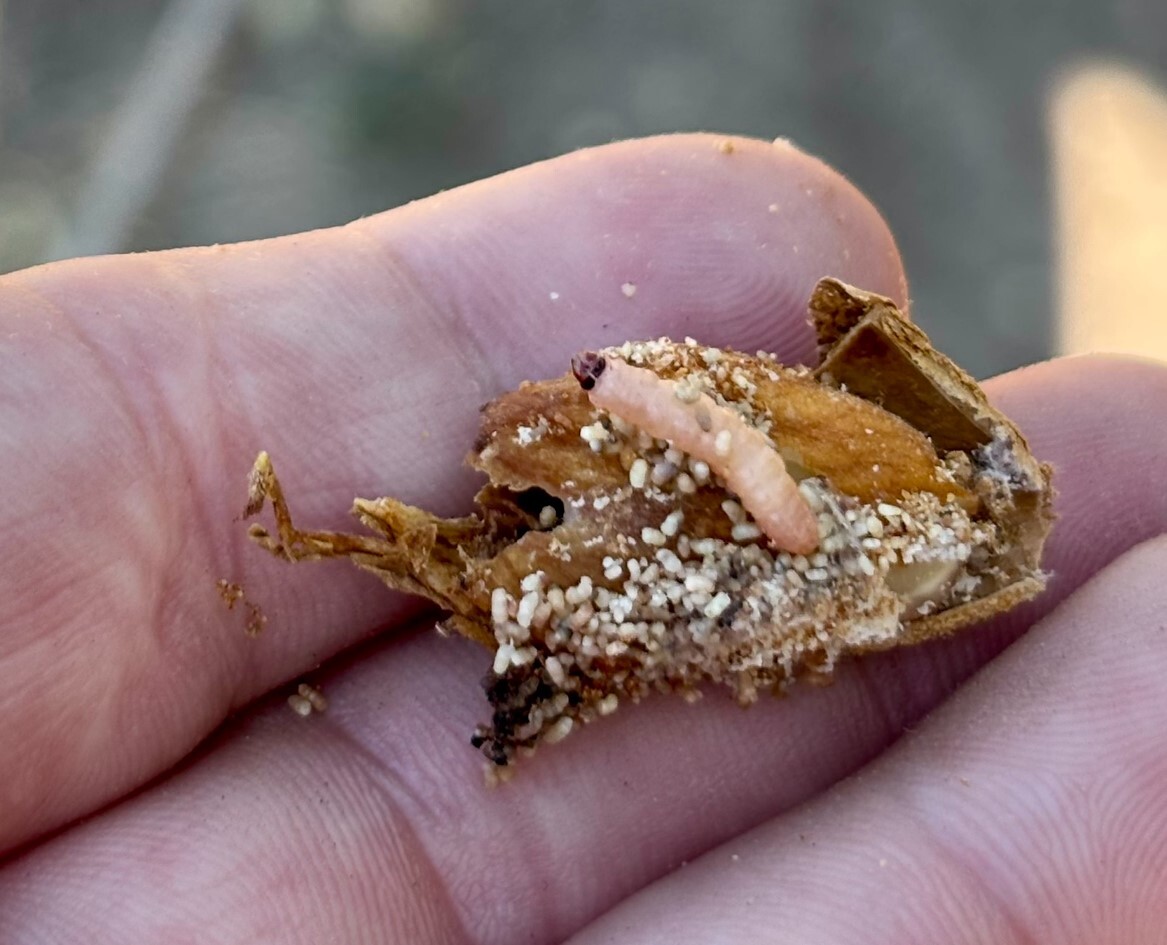
Photo: Dominic Delucci, Suterra Northern California Key Accounts Manager
- On a recent orchard visit in Sutter County, a member of our team stumbled upon a mature navel orangeworm larva. It likely entered the nut during hull split and had been feeding on this kernel for some time, producing a considerable amount of frass.
July 2025
The start of July marks a turning point for California’s orchards. With harvest approaching fast, growers are juggling peak pest pressure, kernel development, and the final decisions that will shape this season’s yield.
Almond Updates
Almonds are entering hull split across much of the state, a key phenological marker and a crucial moment for Integrated Pest Management. At this point, in-season nuts are most susceptible to navel orangeworm damage, so precision treatments are essential.
Growers should consider applications of sprayable mating disruption and traditional insecticides tailored to local degree day models and monitoring data. Because harvest is only a few weeks away for early varieties, July is the time to finish strong and minimize in-season pest damage.
Pistachio Updates
Pistachios continue kernel fill in July. For the most part, shells have completed hardening, and kernels are steadily accumulating carbohydrates, oils, and proteins. Research from UC IPM shows nutrient uptake is helpful, with targeted sprays of potassium or other micronutrients able to supplement quality nut development.
Insect pressure continues to rise, especially in warmer regions where Gill’s mealybug and mites thrive in dry, dusty conditions. Gill’s mealybug feeding can reduce tree vigor and leave sooty mold on pistachio clusters. Dust control and selective treatment can help reduce outbreaks.
Key Considerations
- Navel Orangeworm: Monitor traps and degree day models, align treatments with hull split.
- Gill's Mealybug: Scout regularly and watch for hot spots near clusters.
- Heat Stress: Monitor for leaf turgor and signs of stress as heat intensifies.
- Harvest: Finalize logistics (e.g., equipment, crews, and shaking schedules).