

Contents
Since its commercial debut in the 1980s, mating disruption has earned its place in integrated pest management programs around the globe by helping growers reduce pest pressure and reliance on conventional insecticides. Despite decades of efficacious use in multiple crop systems, misconceptions about this technology continue to circulate around the industry.
As innovators in the mating disruption space, our main goal is to help growers understand the science behind different pheromone delivery systems. Keep reading for a thoughtful breakdown of five of the most common myths surrounding mating disruption.
Misconception #1: Mating disruption does not work in fields with high pest pressure.
One of the most common misconceptions about mating disruption is that it only works when pest populations are low. In reality, mating disruption has been successfully used across a wide range of pest densities, including fields with high pest pressure.
Pests such as navel orangeworm and vine mealybug rely on pheromones to find mates. By disrupting this process, mating disruption reduces successful mating, slows population growth, and ultimately reduces crop damage. While results vary by season and management program, decades of research and commercial use have demonstrated its value in IPM programs. For example, Sharon et al. (2016) reported significant reductions in vine mealybug populations using Suterra's VMB dispensers in vineyards with high pest pressure.
High pest pressure should not be viewed as a barrier to adoption. Mating disruption is a powerful component of IPM programs of many crops and reliably controls different levels of pest pressure.
Misconception #2: Mating disruption is only effective when used on large acreages.
This misconception stems from how mating disruption is evaluated in field trials. Unlike insecticides, which can be tested on individual plants or small plots because they provide direct lethality through pest contact or ingestion, mating disruption works across an area by altering insect behavior via pheromones. Because males can move throughout a block searching for females, researchers typically need larger plots to accurately measure treatment effects and avoid pheromone drift between treatments. Research trials follow a strict protocol to test technologies and validate their results.
Growers should keep in mind that these research requirements should not be interpreted to mean that mating disruption is only effective when used on large plantings. If field trial data for a particular product is supportive, it becomes commercially registered. At this point, the question is not at what acreage it works at, but how much value the right product can provide a grower under commercial conditions.
All of Suterra’s mating disruption solutions have undergone years of rigorous field trial testing. Once deployed, they provide value in fields of any size by reducing pest reproduction, lowering population growth, and helping preserve beneficial insects. This is especially true for mealybug and scale pests, where mating disruption has consistently demonstrated strong performance in tiny plots. Whether applied across a few acres or a large operation, mating disruption remains a sound investment that can improve long-term pest suppression, reduce reliance on insecticides, and support sustainable crop protection.
Success with mating disruption does not depend on the number of acres being treated.
Misconception #3: Mating disruption only works when used over time.
Some growers believe they have to use mating disruption for multiple seasons to see significant results. While long-term population suppression is one of the strengths of mating disruption technology, results are visible after one growing season. When *quality* pheromone delivery systems are deployed at the appropriate time and rate, they begin disrupting immediately. This translates into reduced mating activity, fewer eggs laid, and fewer larvae in the same season. Growers should observe reductions in trap catches (trap inhibition) and crop damage during the first year of use.
The long-term benefits of mating disruption compound over each season, but growers tend to see ROI within the first year.
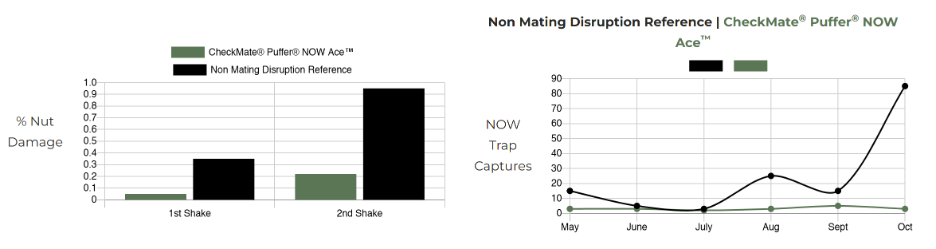 Pictured above: trap capture and damage assessment data based on one year of field trials.
Misconception #4: Mating disruption is too difficult to apply.
Mating disruption technology has come a long way. Today, growers have multiple options including hand-applied dispensers, aerosol emitters, and sprayable formulations. The best application method depends on the crop, pest, labor availability, and pest management goals. Many products only need to be applied once for full season protection and are designed with farming operations in mind to be user friendly, deployed quicky, and fit specific operational needs. Products can be integrated into existing IPM programs and application schedules with no interruption to orchard activities.
With multiple options available, growers can find a solution that is not only effective, but easy to apply and does not interfere with existing farming activities.
Misconception #5: All mating disruption products are the same.
It’s easy to assume all mating disruption products perform the same. In reality, significant differences exist between each mating disruption company, the quality of pheromone used, the efficacy of the formulation beyond the active ingredients, and the caliber of each product design.
Suterra’s headquarters, located in Bend, Oregon, is the largest dedicated pheromone production facility in the US. Our formulation scientists produce the high-quality pheromone active ingredient included in our products, our engineers ensure precise amounts of pheromone are emitted reliably in the field, and our chemists use tools like GC-FID to track pheromone release over the growing season so that crops are protected when it matters most.
Understanding the quality differences in mating disruption products helps growers maximize both performance and return on investment.
Changing Grower Perceptions of Mating Disruption for Good
Mating disruption is a proven technology and should not be devalued by status quo industry myths. It is effective across many pest pressure scenarios, suitable for both small and large acreages, capable of delivering benefits within a single season, and available in multiple application formats. Most importantly, not all mating disruption solutions or pheromone active ingredients are created equal.
As mating disruption technologies continue to advance, growers have more options than ever to incorporate pheromone-based pest management into comprehensive, sustainable IPM programs.