

.jpg)
Contents
Navel orangeworm is one of the most destructive insect pests affecting California nut crops. Almond growers are encouraged to practice winter sanitation to minimize this pest's damage.
By following established sanitation guidelines, growers remove resources for navel orangeworm, reducing its ability to overwinter. This lowers population levels going into next season, meaning less crop damage and inoculum spread.
Keep reading for an overview of winter sanitation in almonds.
What Is Winter Sanitation?
When an almond grower sanitizes their field, they are attempting to destroy as many mummy nuts from trees as possible. Mummy nuts are nuts that remain on trees post-harvest with hull, shell, and kernel intact. They provide habitat for navel orangeworm larvae to survive the winter and resources for egg-laying and larval development the following spring.
While sanitation can be challenging due to labor, weather, and cost, the practice of removing and destroying the nuts left on trees after harvest is an essential component of almond integrated pest management programs. Leaving mummies in trees or intact on orchard floors has been shown to significantly increase NOW populations and damage at harvest, creating steep profit losses for growers. Navel orangeworm damage reduces total yield and price premiums, both important considerations when calculating the return on investment of sanitation.
How Can Growers Effectively Remove Mummy Nuts?
Mummy removal can be accomplished using mechanical harvesters, hand-poling crews, or a combination of the two. Removal of mummy nuts from trees must be followed by effective mowing practices to destroy nuts on orchard floors. Survival of NOW in ground mummies can be high, especially where there is little ground cover and low precipitation during the winter. Equipment operators are advised to keep an eye on mower height and speed, checking to ensure that the ground mummies are adequately destroyed.
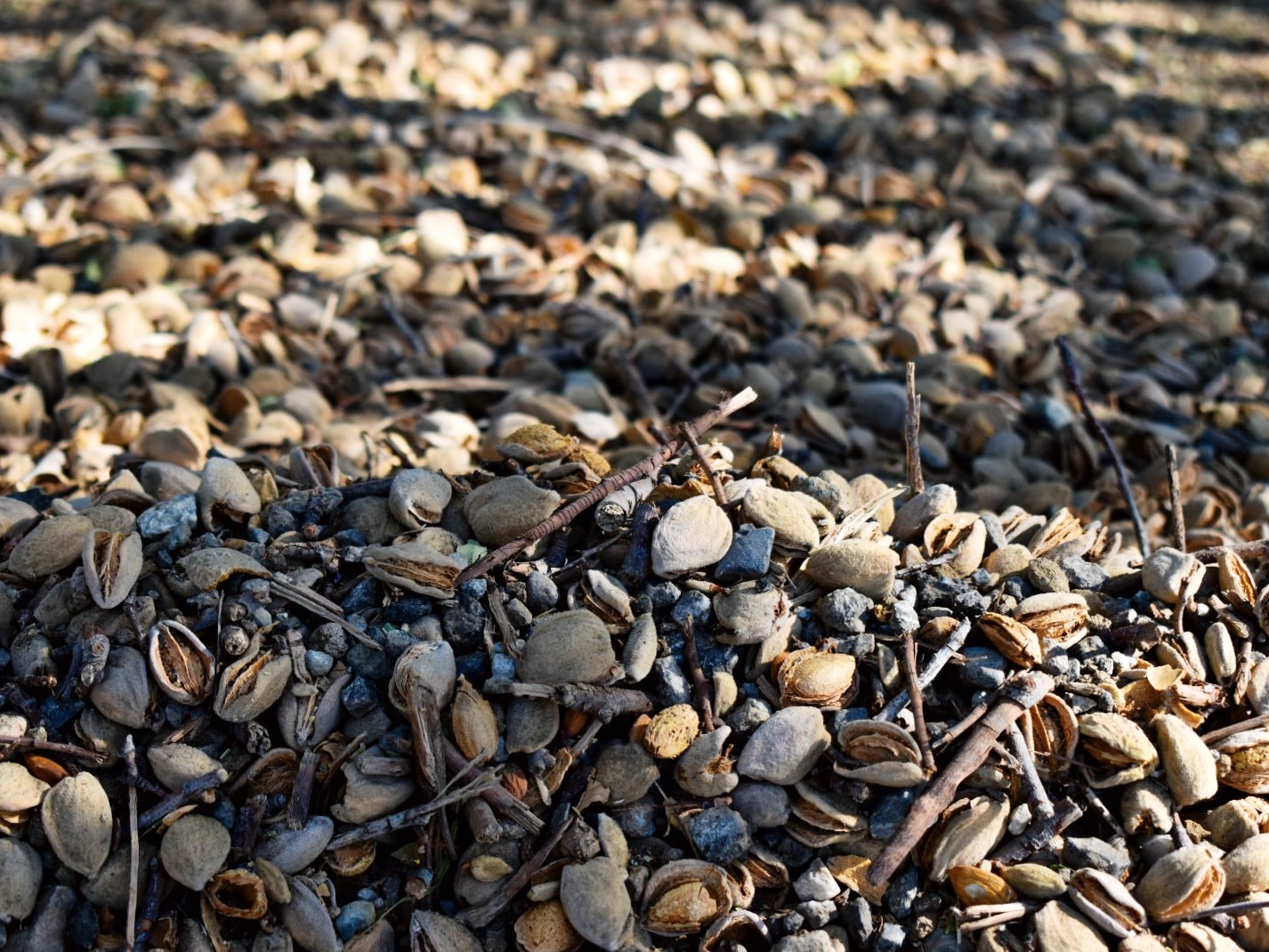
Timing is also important when determining when to mummy shake or pole in order to get the cleanest removal and return on investment. Mummies are most effectively removed after rain or fog events due to their absorption of moisture and increase in weight. However, even in years when environmental conditions do not provide these ideal opportunities, timely sanitation efforts should still proceed. Mummy nuts should be destroyed by mid-March at the latest.
How Does Winter Sanitation Fit into an Integrated Pest Management Plan?
Sanitation in almond orchards is an important part of the IPM toolkit. Like most integrated pest management strategies, it is most effective when used in conjunction with other tactics. NOW damage is lowest when IPM plans include sanitation, mating disruption, timely harvest, and proper use of insecticides.
Mating disruption is a proven technology that protects almonds by preventing NOW adults from reproducing. When used alongside sanitation as the foundation of an IPM program, it has been shown to exponentially decrease pest populations. Sprayable mating disruption products like Suterra's CheckMate NOW-F have unique benefits when applied to target the first flight in spring. Suterra's aerosol Puffers provide season-long protection when hung up in the spring.
Keeping mummy nut removal in the forefront of your mind during post-harvest season can help protect your crop for seasons to come. For questions about your almond IPM plan or mating disruption, contact a Suterra representative here.